
Customs CG, Adeniyi commissions Lagos free zone Green Channel, promises enhanced Trade Facilitation
 Customs CG,Adeniyi Commissions Lagos Free Zone Green Channel, promises enhanced Trade Facilitation
By Babatunde Aremu
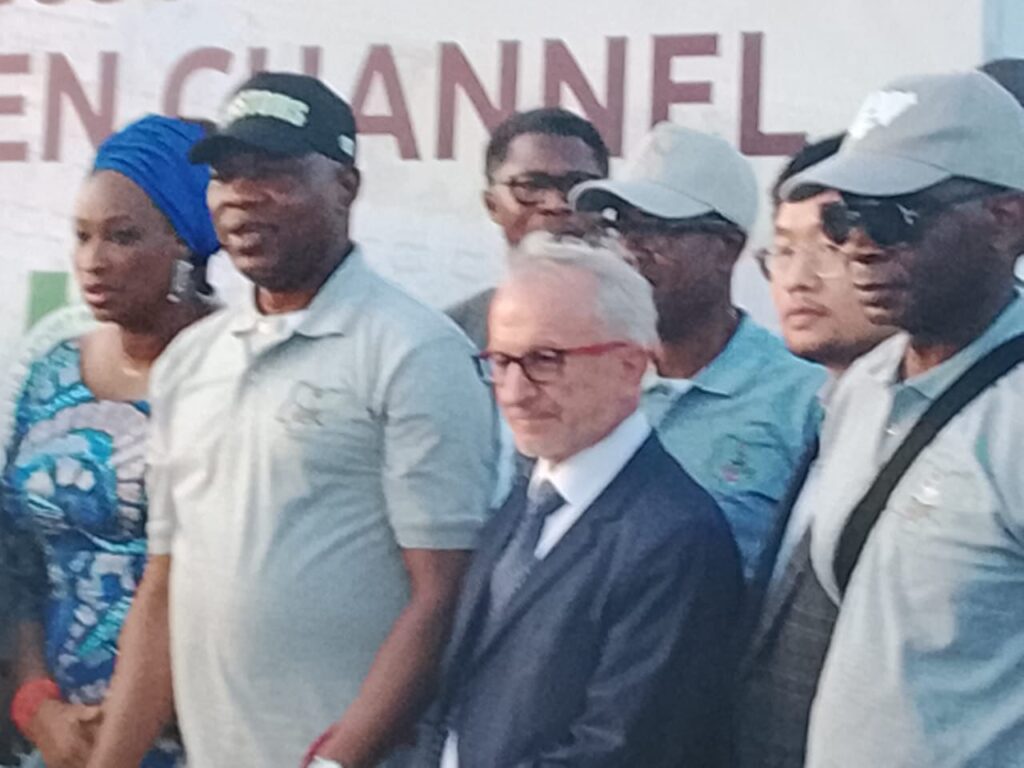
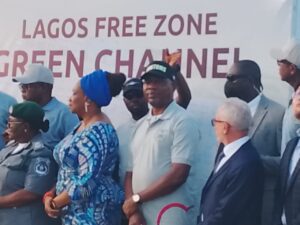
The Comptroller-General of the Nigeria Customs Service (NCS), Bashir Adewale Adeniyi, MFR, on Wednesday commissioned the Lagos Free Zone (LFZ) Green Channel at Itoke Village, Ibeju-Lekki, Lagos, describing the initiative as a major boost to trade facilitation and cargo clearance efficiency.
Speaking with journalists shortly after the commissioning, Adeniyi assured maritime stakeholders, importers, exporters, freight forwarders, and the wider business community that the Green Channel would significantly reduce cargo clearance time and the cost of doing business at Nigerian ports.
According to the Customs boss, the intervention directly addresses long-standing bottlenecks in port operations. “This initiative speaks to trade facilitation. It reduces the time spent on cargo clearance and lowers the cost of doing business at our ports. Containers discharged from vessels are moved immediately through a dedicated Green Channel for examination,” he said.
Adeniyi noted that the new process replaces what he described as the former “exuberant” and time-consuming procedures associated with accessing examination bays. “What we saw today reflects the trust investors have in us and the confidence we also have in them,” he added.
On revenue generation, the CGC explained that improved efficiency would naturally translate into higher collections. “Once we reduce clearance time and costs, revenue will increase automatically,” he assured.
Further explaining the operational impact, Adeniyi said the Green Channel resolves challenges associated with container stacking and traceability at larger ports. “Containers are moved from vessels to a dedicated examination area where their movement can be tracked online. This transparency makes it an idea that deserves time to work,” he said.
He added, with a light-hearted remark, that the corridor is called a “Green Channel” because it is clearly marked in green and free of encumbrances. However, he clarified that the status is conditional: “Once a container is stopped along the corridor or subjected to intervention by another agency, it ceases to be ‘green’.”
Responding to questions on daily container capacity, Adeniyi explained that volumes depend on vessel arrivals, noting that Customs does not determine the number of containers presented for assessment.
In a separate briefing, the management of Lagos Free Zone described the Green Channel as an NCS-approved, dedicated logistics corridor designed to fast-track cargo movement between Lekki Deep Sea Port and the Lagos Free Zone.
The Managing Director/Chief Executive Officer of Lagos Free Zone, Adesuwa Ladoja, said the initiative gives LFZ-based companies a strong operational advantage. “The Green Channel enables cargo to move seamlessly from vessel to factory or warehouse through a secure, customs-controlled route,” she said.
She listed key benefits to include faster time to market—cutting clearance timelines from 24–48 hours to just a few hours—lower logistics and demurrage costs, predictable supply chains, enhanced competitiveness for manufacturers and exporters, and regulatory certainty with full customs oversight.
Explaining how the system works, LFZ management said cargo discharged at Lekki Deep Sea Port is moved directly under Customs supervision through the dedicated corridor to the Free Zone, where inspection, verification, and final reconciliation are completed.
On the broader economic impact, the management noted that the Green Channel strengthens Lagos Free Zone’s position as a leading hub for manufacturing, logistics, and export-oriented industries, while supporting Nigeria’s trade facilitation agenda and enhancing the country’s competitiveness as a West African trade and production hub.